


Best Practices for Fire Extinguisher Maintenance and Service
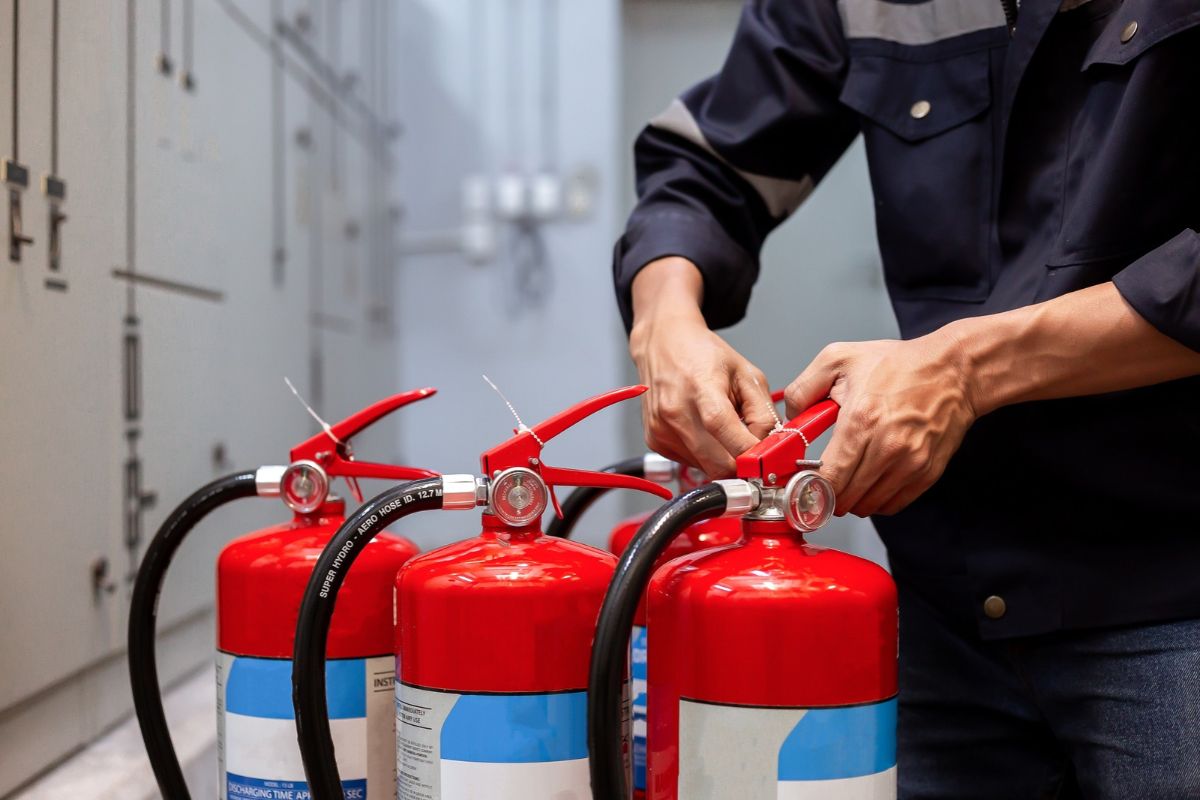
Best Practices for Fire Extinguisher Maintenance and Service
A portable fire extinguisher is the only piece of fire protection equipment in most buildings that an ordinary occupant is expected to operate, usually within the first minute of a fire, usually without having touched one before.
It is also the piece of equipment most likely to have been quietly neglected. Extinguishers get moved, blocked, borrowed, knocked, slowly depressurised and painted around. Unlike a sprinkler head or an alarm panel, nothing monitors them, so a unit that will not discharge looks exactly like one that will.
The maintenance requirements exist to close that gap, and they are more specific than most building owners realise.
Who Sets the Requirements
In British Columbia the obligation sits with the BC Fire Code, which requires fire protection equipment to be maintained in operating condition and adopts the recognised standard for portable extinguishers, which is NFPA 10.
That standard is where the intervals come from. The local fire department, as the authority having jurisdiction, enforces it and may have additional expectations, and your insurer will usually want to see the records as well. The practical consequence is that the schedule below is not optional good practice. It is the baseline for compliance.
The Intervals That Matter
Four distinct activities happen on four different cycles, and conflating them is the most common record-keeping failure.
Monthly inspection is a quick visual check, and it can be done by staff rather than a technician. It is recorded, and the record is what an inspector asks for first.
Annual maintenance is a thorough examination carried out by a trained and qualified person, covering the mechanical parts, the extinguishing agent and the expelling means. The unit is tagged with the date and the technician's identification.
Internal examination comes at longer intervals depending on the type of extinguisher. For the stored-pressure dry chemical units found in most corridors and vehicles, this falls at six years: the extinguisher is emptied, examined internally and recharged.
Hydrostatic testing is the longest cycle and tests the integrity of the cylinder itself. Stored-pressure dry chemical extinguishers are generally tested at twelve years. Carbon dioxide, water and wet chemical cylinders, along with hose assemblies, are on a shorter five-year cycle.
One additional rule overrides all of the above. Any extinguisher that has been discharged, even partially, even for a few seconds, must be recharged before it goes back on the wall. A partially used extinguisher is not a partially useful one.
What the Monthly Check Should Cover
This takes a couple of minutes per unit and catches the majority of real-world failures. Walk the building and confirm the following for each extinguisher:
- It is in its designated location, on its bracket or in its cabinet, and has not been moved
- It is visible and unobstructed, with signage in place where the unit itself is not immediately obvious
- The pressure gauge needle sits in the operable range rather than in the recharge or overcharge zone
- The tamper seal and pull pin are intact and have not been disturbed
- There is no dent, corrosion, leakage or damage to the cylinder, hose, horn or nozzle
- The operating instructions are legible and facing outward
- The unit feels full when lifted, and the inspection tag is present with the dates recorded
Record the check with a date and initials, on the tag or in a log. An inspector who finds a building with good equipment and no monthly records is looking at a deficiency, and the converse is also true: diligent records make every other conversation easier.
Placement and Access Are Part of Maintenance
A correctly serviced extinguisher that nobody can reach in time has failed, and placement problems are among the most frequent findings in commercial buildings.
Mounting height is specified. For units weighing up to about forty pounds the top of the extinguisher should sit no more than roughly 1.5 metres above the floor, and heavier units lower than that, with the bottom kept clear of the floor by at least about 100 millimetres. The point of the limits is that an extinguisher has to be liftable by an average person without a struggle.
Travel distance is specified as well, and it is based on the hazard present. For ordinary combustibles, an occupant should not have to travel more than about 23 metres to reach an extinguisher. For flammable liquid hazards the permitted distance is considerably shorter, and for commercial cooking hazards it is shorter still. Those distances are measured along the actual path of travel, not across the floor plate.
Then there is the simple matter of obstruction. Extinguishers end up behind stacked stock in warehouses, behind doors in offices, inside cabinets in tenant spaces that nobody realises are cabinets, and behind seasonal displays in retail. Correcting this costs nothing and is the single most valuable thing a walk-through achieves.
Matching the Extinguisher to the Hazard
An extinguisher rated for the wrong class of fire is worse than no extinguisher, because somebody will use it.
The classes are straightforward. Class A covers ordinary combustibles like paper, wood and textiles. Class B covers flammable liquids. Class C covers energised electrical equipment. Class D covers combustible metals, which is a specialised industrial concern. Class K covers cooking oils and fats, and it is the one most often missing where it is needed.
Commercial kitchens are the recurring example. Cooking oil fires behave differently from ordinary fires, and the wet chemical agent in a Class K extinguisher is formulated to deal with them. A general-purpose dry chemical unit mounted beside a deep fryer can scatter burning oil. If your building has a commercial kitchen, confirming that the appropriate Class K units are present, correctly placed and currently serviced is worth doing this week rather than at the next inspection.
Server rooms, electrical rooms, paint and chemical storage, vehicle bays and machine shops each have their own appropriate selections, and a hazard assessment is what matches them properly.
What Usually Gets Found
Across inspections in Metro Vancouver buildings, the same handful of issues come up again and again.
Tags that have expired, or are missing entirely after a unit was swapped out. Extinguishers blocked or relocated by tenants without anyone being told. Pressure gauges reading low on units that have been on the wall for years. Missing pull pins and broken seals, usually from curiosity rather than use. Corrosion on units mounted in parkades, loading bays and exterior locations. Kitchen hazards protected by the wrong class. And units in service well past their hydrostatic test date, which is the one that makes a cylinder a safety concern in its own right.
Almost every one of those is inexpensive to correct and awkward to explain after an incident.
Keep the Records Together
The administrative side carries real weight, because compliance is demonstrated through documentation rather than through good intentions.
Keep the monthly inspection log, the annual service records, and the internal examination and hydrostatic test records, and keep them where they can be produced on request rather than in a drawer in a suite that has changed hands. Maintain a list of every extinguisher in the building with its location, type, size and service dates, because buildings lose track of equipment far more easily than they lose track of rooms. Where a unit is replaced, update the list rather than assuming the tag tells the whole story.
For most owners and property managers the sensible arrangement is to put the annual work on a schedule alongside the building's other fire inspections, so that extinguishers, alarms, sprinklers and emergency lighting are not each tracked separately. We cover fire extinguisher inspections on site, including recharging, six-year maintenance and hydrostatic testing, with reports back within a day.
Emergency lighting is the item most often forgotten in the same cycle, and it has its own inspection requirements. We have written separately on emergency lights maintenance and regular inspection if that is also on your list.
Equipment Is Only Half of It
The last piece is the one no service visit addresses. An extinguisher is useless if the people in the building do not know where it is, which class it is, how to operate it, or when not to attempt a fire at all. A short session covering the discharge technique and the decision to evacuate instead changes outcomes more than any amount of hardware, and fire safety training is straightforward to arrange alongside a service visit.
Book a Service Visit
Radius Fire provides fire protection inspection, installation, monitoring and safety planning across Metro Vancouver from Richmond, including portable extinguisher service with on-site recharging.
If you are not confident your extinguishers are current, or you have had a notice from the fire department, call (604) 232-3473 or contact us and we will sort out what you have and what it needs.


